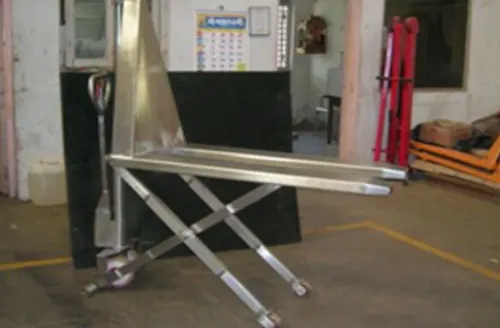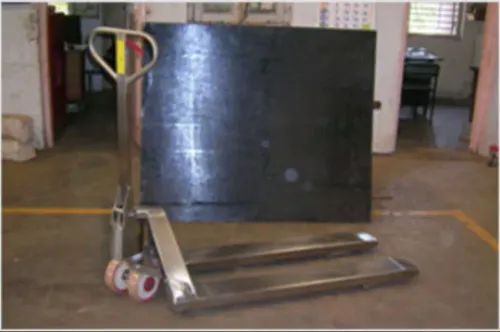
A business does not always need fully powered equipment for every lifting task. Where palletized loads are handled at moderate frequency and within suitable capacities and heights, Manual Hydraulic Stackers can provide a practical solution for lifting and positioning materials.
The challenge is choosing a stacker based on the actual job rather than selecting one simply from its stated maximum capacity.
For small warehouses, workshops, manufacturing units, stockrooms, and industrial facilities in Mumbai, several operational details should be reviewed before purchasing.
Start With the Real Load
Rated capacity is an essential specification, but buyers should examine the complete load rather than estimating its weight.
Consider the pallet, packaging, goods, containers, and any other items that contribute to total load weight. Load dimensions and weight distribution also affect handling.
A compact but dense component may behave differently from a large, evenly distributed pallet even when their total weights are similar.
Define the Required Lift Height
Ask where the load actually needs to go.
Is the stacker required for low-level positioning, occasional stacking, or placing materials at a specific working height? Selecting unnecessary lift height may provide little operational benefit, while insufficient height can make the equipment unsuitable from the beginning.
Buyers should also evaluate equipment dimensions and available overhead clearance.
Check Pallet Compatibility
Not every pallet works with every stacker configuration.
Fork dimensions, pallet entry arrangement, and any supporting structure beneath the load should be checked carefully. This is especially important for businesses using several pallet designs within the same facility.
A stacker that cannot correctly engage the company's regular pallets will quickly become an operational limitation.
Measure the Working Area
Mumbai warehouses and industrial units often need to make efficient use of available floor space. Measure aisles, doorways, turning areas, storage locations, and the spaces where loads will be picked up and deposited.
Do not evaluate manoeuvrability in an empty warehouse alone. Normal operations may include parked pallets, racks, machinery, employees, and temporary staging zones.
Floor quality should also be considered because material-handling equipment performs best on appropriate, reasonably level surfaces.
Consider How Often It Will Be Used
Manual equipment can be well suited to occasional or moderate handling requirements. As movement frequency increases, the physical effort and time involved should become part of the purchasing decision.
High-volume operations may need to compare manual equipment with semi-electric or fully electric alternatives.
Robotic Equipments supports businesses evaluating material-handling equipment in Mumbai and Maharashtra. When selecting Manual Hydraulic Stackers, create a simple specification covering maximum actual load, lifting height, pallet type, aisle conditions, movement frequency, and operating environment. This provides a much stronger basis for procurement than comparing capacity and price alone.